Table of Contents
Inner Critic: How to Build Positive Self-Talk
Introduction: Naming the Voice Within
“The inner critic isn’t inherently malicious. It’s fear wearing a clever disguise.”
It’s not always the obstacles outside of us that slow us down. Often, it’s the quiet, persistent voice inside—the one that questions, judges, and second-guesses every move. The one that appears just as we’re about to begin or right after we’ve taken a risk. The voice that says, “You’re not good enough,” “You’ll mess this up,” or “Who do you think you are?”
This is the inner critic. We all have one.
Sometimes, it sounds like a concerned parent, a critical teacher, or the harsh echo of an old failure. Other times, it blends so seamlessly with our thoughts that we don’t even recognise it as separate from ourselves. It poses as logic, caution, or realism—but more often than not, it’s simply fear wearing a clever disguise.
The inner critic isn’t inherently malicious. In fact, it usually believes it’s protecting us—from embarrassment, rejection, disappointment, or hurt. But in doing so, it can create something far more paralysing: stagnation. Listening to it without question holds us back from progress, creativity, and connection. We lose momentum, not because we’re lazy or incapable, but because we’re at war with ourselves.
In this article, we’ll explore the inner critic, how it breaks our stride, and, most importantly, how we can change the conversation because the voice in your head isn’t fixed. And when that voice becomes kinder, more supportive, and more honest, everything begins to shift.
Let’s take a closer look.
1. The Psychology of the Inner Critic
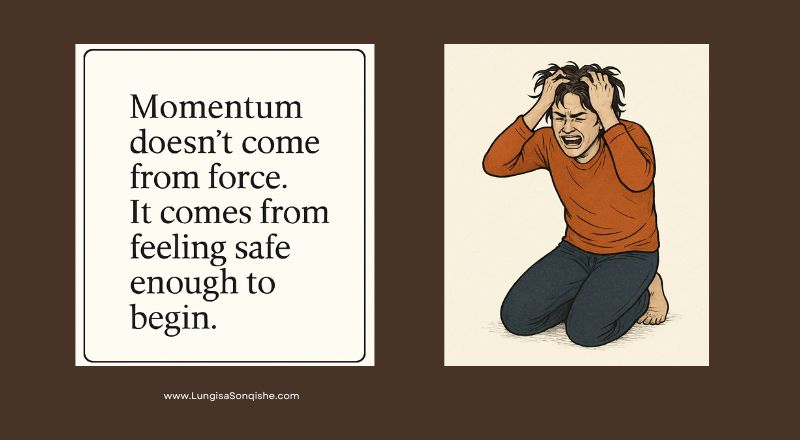
“Momentum doesn’t come from force. It comes from feeling safe enough to begin.”
The inner critic doesn’t come out of nowhere. It has roots—often deep ones.
From an early age, many of us learn to shape our behaviour to gain approval, avoid punishment, or stay safe. We internalise voices from parents, teachers, or even the culture around us; over time, those voices become our own. What once may have been helpful guidance turns into a rigid internal monologue—judging instead of guiding, punishing instead of protecting.
Psychologists often view the inner critic as part of the **ego’s defence system**. Its purpose? To prevent emotional pain. If we never try, we can’t fail. If we don’t speak up, we can’t be judged. If we expect the worst, we won’t be disappointed.
The logic is flawed, but fear rarely operates in logic.
The challenge is that this kind of self-talk doesn’t keep us safe—it keeps us small.
Because the inner critic is subtle, we often don’t realise how powerful it is. It shapes how we show up at work, in relationships, in creativity, and in moments of decision-making. It keeps us cycling in self-doubt, waiting to feel “ready” or “good enough” before we take a step forward.
But here’s the truth: that step rarely comes from confidence—it comes from compassion.
Before we can build momentum, we must understand what’s been breaking it. And more often than not, it’s not a lack of ability or opportunity—it’s the story we’re telling ourselves about who we are and what we’re allowed to become.
“You won’t always silence the inner critic. That’s not the point.”
Momentum doesn’t only rely on skill, energy, or time—it depends on belief. The belief is that taking action is worth it. That your efforts matter. That you are, in some way, capable or deserving of what you’re working toward.
The inner critic chips away at that belief.
It doesn’t always shout. Often, it whispers just loudly enough to make you hesitate. And hesitation—when repeated enough—becomes a habit—a way of life.
Here are a few common ways the inner critic breaks momentum:
✦ Procrastination masked as perfectionism
“I just want to get it right.”
At first glance, it sounds responsible. But often, it’s fear in disguise. The inner critic says, “Don’t start unless it’s perfect,” which usually means, “Don’t start at all.”
✦ All-or-nothing thinking
“If I can’t do it all now, there’s no point.”
The inner critic thrives in extremes. It convinces us that if our effort isn’t complete, constant, or impressive, it isn’t worth making.
✦ Comparison and imposter syndrome
“Others are better at this—why bother?”
This voice magnifies others’ successes and minimises our own. It forgets that everyone started somewhere—and that self-trust builds in motion, not waiting.
✦ Emotional shutdown
“What if I fail?” → “Don’t feel. Don’t try. Stay still.”
When the inner critic gets too loud, our nervous system may default to freeze mode. We go numb. We disconnect. We don’t move, not because we don’t want to—but because we’ve convinced ourselves it’s safer to stay invisible.
These patterns are incredibly common—and they are not personal flaws. They are survival strategies that have simply outlived their usefulness. When we begin to recognise them, we begin to reclaim our momentum—not by fighting ourselves but by changing how we relate to the voice within.
3. How Constructive Self-Talk Builds Momentum
“Constructive self-talk means offering yourself the same tone you’d use with a dear friend.”
If the inner critic pulls us back, supportive self-talk gently urges us forward—not with empty praise or forced positivity but with honest, kind encouragement rooted in possibility.
It’s important to note that constructive self-talk doesn’t mean pretending everything’s fine when it isn’t. It means offering yourself the exact tone you’d use with a dear friend: grounded, compassionate, realistic, and hopeful.
Here’s how constructive self-talk supports momentum:
✦ It creates psychological safety
When your inner voice speaks with care instead of criticism, your nervous system relaxes. You feel less threatened by mistakes and more open to learning. And that’s when you begin to move—with curiosity instead of fear.
“It’s okay not to know everything. I can figure this out.”
✦ It breaks perfectionism’s grip
Supportive self-talk allows progress without pressure. It reminds you that even messy, imperfect action is worthwhile.
“This version doesn’t need to be perfect. It just needs to exist.”
✦ It builds resilience through compassion
When you stumble (because you will), a kinder inner voice helps you recover faster. Instead of spiralling into shame, you regroup with care and carry on.
“That didn’t go how I’d hoped—but it doesn’t mean I’ve failed.”
✦ It reminds you that effort matters
The inner critic focuses on outcomes. Supportive self-talk values effort and intention, which fuels momentum even when results are slow to show.
“Showing up today was an act of strength. I’m proud of that.”
Momentum isn’t built in giant leaps but in gentle nudges. And when those nudges come from within, they carry a power that no external push can match.
You don’t have to be your loudest cheerleader. But you can be your quietest ally.
4. Tools to Reframe the Inner Voice
“When the voice becomes kinder, more supportive, and more honest—everything begins to shift.”
Changing the way you speak to yourself isn’t about becoming relentlessly positive. It’s about becoming more truthful, compassionate, and intentional with your inner language.
Here are some simple, powerful tools to help you reframe your self-talk and soften the inner critic’s grip:
1. Name the Inner Critic
Giving the inner critic a name can help distance you from that voice. It reminds you that those thoughts are part of you but not all of you.
Example: “Oh, that’s just Doubtful Denise again,” or “Here comes The Voice of Doom…”
Humour softens tension. Distance creates choice.
2. Ask: “Is this true?”
When you notice a critical thought, pause and gently question it. Most inner criticism is exaggerated, outdated, or inherited.
Instead of: “I always mess things up.”
Ask: “Is that really true? Or am I afraid of making a mistake?”
Truth often sounds quieter than fear—but it holds more weight.
3. Reframe, don’t deny
Don’t battle the critic—reframe its message. What is it trying to protect you from? What’s a more supportive way to express that fear?
From: “You’re going to embarrass yourself.”
To: “This feels risky because you care—but it’s safe to try.”
4. Use Self-Compassion Phrases
Borrow gentle language from self-compassion practices. Here are a few:
- “This is a moment of difficulty. That’s okay.”
- “Others feel this way, too. I’m not alone.”
- “I can be kind to myself in this moment.”
Say them aloud. Repeat when needed. Write them somewhere visible.
5. Keep a Thought Log
Jot down your inner dialogue for a week—especially during challenging moments. What’s the tone? The language?
Then try writing a second column: What would I say to a friend in the same situation?
You’ll begin to spot the contrast, and over time, you’ll incorporate those friendlier words into your inner script.
6. Create a “Supportive Self” Voice
Write a few phrases or affirmations from the perspective of the part of you that wants to grow. Keep them close.
Examples:
- “Progress counts, not perfection.”
- “I’m allowed to be learning.”
- “I don’t need to prove anything—I just need to begin.”
5. Call to Reflection
Now that we’ve explored how the inner critic works—and how we can speak to ourselves differently—it’s time to turn inward.
Self-awareness is where all meaningful change begins. So take a moment. Breathe. And ask yourself:
✧ What is the tone of your inner voice when you’re trying something new?
Is it calm and curious, or sharp and doubting?
✧ Whose voice does your inner critic sound like?
A parent? A teacher? An old version of you?
✧ What is your inner critic trying to protect you from?
Disappointment? Rejection? The risk of being seen?
✧ What would change if your inner voice became your ally instead of your judge?
There’s no need to answer these all at once. However, they may be worth revisiting over time, especially in moments of challenge or transition.
Consider journaling your responses or writing a letter from your inner critic, followed by one to your inner critic. These simple exercises can surface unconscious beliefs and begin to reshape your relationship with your mind.
Remember: the goal isn’t to silence the critic completely. It’s to listen with discernment—and respond with compassion.
Conclusion: Voice as a Choice
The voice in your head matters more than you may realise. It’s the one you’ll hear most often, in the quiet before a decision, in the aftermath of a mistake, in the uncertain space between effort and outcome.
When that voice is harsh, momentum falters. But you begin to move differently when it becomes softer—more honest, more encouraging. You take steps not because you feel invincible but because you feel supported, even by yourself.
You won’t always silence the inner critic. That’s not the point.
The point is to build a second voice—a wiser one. One that speaks with kindness.
One that says:
“You’re allowed to try.”
“You’re allowed to learn.”
“You’re allowed to be unfinished and still moving forward.”
And with each step you take, that gentler voice grows stronger.
Momentum doesn’t come from force.
It comes from feeling safe enough to begin.
And you are.
You are safe.
You are enough.
You are already on your way.
Book Recommendations
- The War of Art by Steven Pressfield — A powerful look at internal resistance and how it prevents creative work.
- Radical Acceptance by Tara Brach — A deeply compassionate guide to embracing your whole self, including your inner critic.
- Self-Compassion by Kristin Neff — Grounded research and practices for transforming self-talk through kindness.
- The Gifts of Imperfection by Brené Brown — Encouragement to let go of shame, perfectionism, and comparison.
- Chatter by Ethan Kross — A fascinating dive into how our inner dialogue affects decision-making and stress.
- The Mountain Is You by Brianna Wiest — Focused on turning self-sabotage into personal power and emotional growth.
- Mindset by Carol Dweck — A transformative take on the growth vs fixed mindset and how our beliefs shape behaviour.

Find Out More & Book a Session
About Lungisa E Sonqishe
ELEVEN11:Mindset+ : eleven11mindsetplu.com